Will Wwe Ever See the Demon Again
One-way journey —
Starman is out there, merely we probably won't see him again until 2047
All hereafter predictions had to be based on just seven weeks of loftier-quality data.
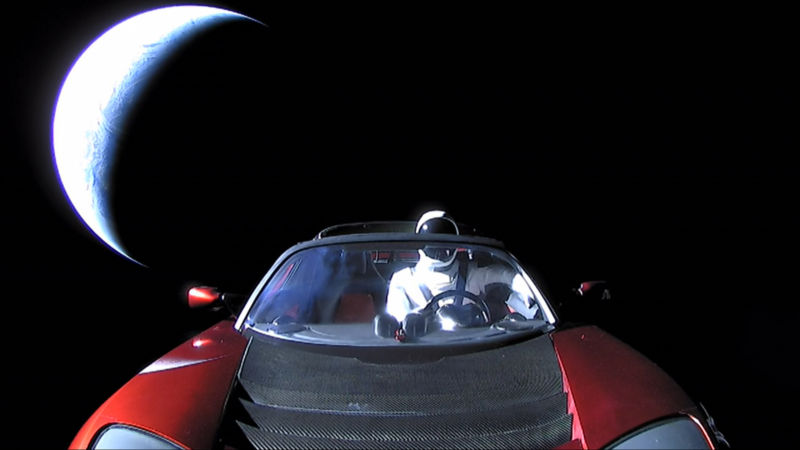
Overstate / A launch-day photograph of Starman leaving Earth'southward orbit.
SpaceX
A little more than a yr ago, SpaceX launched Elon Musk's personal Tesla Roadster, complete with a mannequin nicknamed Starman, wearing a SpaceX Dragon spacesuit. About six hours later, the Falcon Heavy rocket's upper stage fired for a final time, sending Starman into an orbit effectually the Sun, with an aphelion just beyond the orbit of Mars. Since and then I, and others, have wondered what the long-term fate of Starman will be.
At get-go, not much was known about the Tesla'southward location. The first inkling of its orbital parameters came from an epitome that Musk tweeted. (After, this turned out to be inaccurate). The first verified and publicly bachelor location information came from the Joint Infinite Operations Middle (JSpOC), the US Air Strength command tasked with tracking objects in space. Simply this only covered the time it was in World orbit, not Starman's position after the last upper-stage burn. Using those two pieces of data, on February 7, I created a website that allowed a person to see how far away the Tesla was from Earth. Simply this data was quite express at first.
The next scrap of information came from JPL Horizons, a tool produced past JPL's Solar System Dynamics organization that is tasked with tracking objects in the Solar System. On February 8, it used information provided straight from SpaceX to allow one with proper knowledge to query the organization and determine exactly where Starman was at any given fourth dimension. This provided useful information for a few months, merely across that fourth dimension period, the data just could non provide enough information.
Over the ensuing months, JPL received tracking information provided by optical telescopes that allowed information technology to refine the trajectory for Starman. Some people fifty-fifty used this early information to predict Starman's long-term future; nevertheless, the data had a very short arc and was but actually reliable for a few years at best. The best-known endeavour predicted that Starman would pass close to Earth in 2091 and resulted in a newspaper entitled "The Random Walk of Cars and Their Collision Probabilities with Planets." Only that initial 2091 prediction was inaccurate because the tracking information relied on only a week's worth of observational data.
JPL Horizons produced its final solution at the end of March 2019. This came after the last known telescope to observe Starman, a one-meter instrument at Las Cumbres Observatory near Sutherland, South Africa, did so on March 19, 2019. After that time, all future predictions had to be based on but seven weeks of loftier-quality data.
These predictions are made past taking the position in the sky of the observations and using that to fit a model of the orbital path around the Sun. With seven weeks of data, we can get a pretty proficient estimate of that path, and the current predictions have a calculated uncertainty of only a few kilometers. There are some consistent errors that evidence upward when computing such information, the virtually common being steady non-gravitational acceleration. This tin can be caused past the small, steady pressure of sunlight, differences in the temperature of different sides of the vehicle, and out-gassing. (Outgassing is an effect of sunlight humid some of the non-metallic parts of the vehicle, which will cause a pocket-sized pressure difference over time.)
The measurements that have been made of Starman show that information technology is being pushed slightly away from the Sun. The information should be very accurate for about 50 years, but equally it has shut passes with planets, specially Earth, that uncertainty will abound considerably. Afterwards 100 years it will be much less reliable.
What nosotros can say for now
The next time Starman will pass close to a planet will be to Mars on October 7, 2020. This will not exist a particularly close laissez passer; it will be nearly 4.6 meg miles (7.4 one thousand thousand km) away from Mars. At that distance, Mars volition appear simply equally a tiny dot, equally seen in this simulation. This will not be enough to significantly alter the orbit of the Tesla.
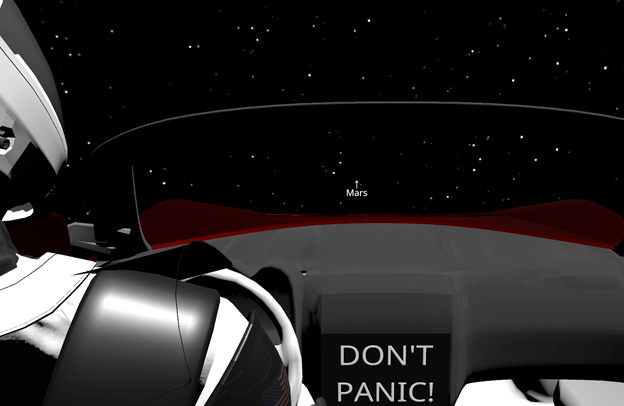
False view of Starman on October 7, 2020.
Ben Pearson/ Where is Roadster 3D simulator
At that place are many instruments at Mars—could any of them come across Starman in 2020? The biggest telescope near Mars is the HiRISE instrument, which has occasionally imaged bright stars, and fifty-fifty Jupiter. Withal, it is non configured equally an astronomical telescope and, due to its blueprint, can only see bright objects, and so it would not work to image Starman, which is predicted to be a magnitude 22 object as seen from Mars in 2020.
A much closer pass will happen at Mars on April 22, 2035. The altitude this time will only be about 1.four million miles (2.3 million km), and has a small gamble of existence much closer. The predicted error is higher the farther in fourth dimension one goes, just at this bespeak things are still accurate plenty to be very confident it will be that close to Mars within iii hours of the prediction.
It is theoretically possible that a telescope could exist placed on Mars by 2035 that volition exist able to observe Starman. A one-meter telescope, such as the South African telescope that final observed Starman, could hands practise it. With and so many new super-heavy rockets being planned, one of them could possibly carry such a payload to Mars past then.
(It is worth noting that, in order to resolve more than a dot, Starman would take to brand a pass within 37,000 miles (lx,000km) of a telescope 10m (33 feet) in diameter. This is the size of the largest telescopes on Globe, so unless Starship starts flight by Starman as part of a Solar Arrangement cruise, we may never resolve the Tesla or Starman again.)
How about the adjacent Earth flyby? Close approaches to Globe are predicted to happen near every 30 to 35 years, often in pairs. The starting time of these close passes will occur on January 11, 2047. The distance is predicted to be about iii million miles (4.8 meg km), which is close plenty that it can certainly be seen from Earth, about four times closer than the last reported observation of Starman from South Africa. These new observations should allow u.s.a. enough data to better predict its journey throughout the Solar System for many hundreds of years to come. Starman will too make a second, slightly more than afar pass in 2050.
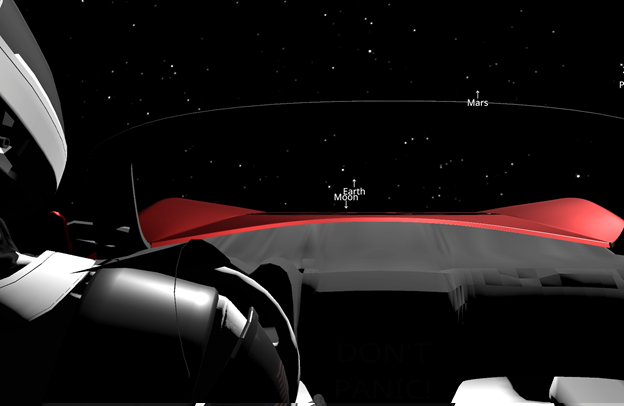
Simulated view of Starman on January 11, 2047.
Ben Pearson/ Where is Roadster 3D simulator
Afterwards this betoken in time, measurements become much less certain. A very small fault becomes a much larger one over so many years, and small errors are magnified by a huge margin when passing shut to a body such as Globe. Furthermore, predictions are complicated by non-gravitational forces such as sunlight; we do non know how Starman is oriented, which will greatly influence this strength.
From 2050 to 2085, we know that Starman will be in the region betwixt Globe and Mars, making a few distant flybys of Mars, but none particularly close, likely no closer than it volition be in 2020. The next time it volition exist shut to Globe is around January i, 2085, but the predictions are much less sure that far out—it could be off by as many as 4 days in either direction. A 2d close arroyo will happen around March ix, 2088.
Beyond this point we only don't have much data, merely the current predictions are for close approaches in 2119 and 2123 to Earth. Across this bespeak in time, it is extremely difficult to know if a close approach volition even happen at that time. During this entire menses of time Starman is predicted to remain in roughly the same orbit, although there is a significant chance its orbit might start to reach out farther, possibly even reach the Asteroid Belt every bit Elon Musk initially stated.
Beyond simply tracking cars roaming through deep space, this kind of analysis can be helpful in other means. Tracking asteroids and comets is extremely important; if one were to hit the World it could cause tremendous amounts of impairment. Using the aforementioned tools that were used to make these predictions, scientists and engineers tin predict the path of well-nigh-Earth objects that might someday hit our planet. These objects, like Starman, cannot be seen continually, and thus we must predict their paths with limited data—sometimes for many years into the future.
kulikowskidins1974.blogspot.com
Source: https://arstechnica.com/science/2019/04/starman-is-out-there-but-we-probably-wont-see-him-again-until-2047/
0 Response to "Will Wwe Ever See the Demon Again"
Post a Comment