What Kind of Art Di D the Shawnee Do
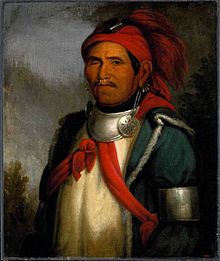 The Shawnee Prophet, Tenskwatawa (1775–1836), ca. 1820, portrait by Charles Bird King | |
| Total population | |
|---|---|
| seven,584 enrolled[1] | |
| Regions with significant populations | |
 The states ( The states (  Oklahoma), formerly Oklahoma), formerly  Ohio, Ohio,  Pennsylvania, Pennsylvania,  Indiana, Indiana,  Alabama[ii] [ane] Alabama[ii] [ane] | |
| Languages | |
| Shawnee, English | |
| Religion | |
| traditional religions and Christianity | |
| Related indigenous groups | |
| Miami, Menominee, Cheyenne[three] |
The Shawnee are an Algonquian-speaking ethnic people of the Northeastern Woodlands. In the 17th century they lived in Pennsylvania, and in the 18th century they were in Pennsylvania, Ohio, and Indiana with some bands in Kentucky and Alabama.[2] By the 19th century they were forcibly removed to Missouri, Kansas, Texas, and ultimately Indian Territory, which became Oklahoma[two] under the 1830 Indian Removal Act.
Today Shawnee people are enrolled in three federally recognized tribes, all headquartered in Oklahoma: the Absentee-Shawnee Tribe of Indians of Oklahoma, Eastern Shawnee Tribe of Oklahoma, and Shawnee Tribe.
Etymology [edit]
Shawnee has also been written as Shaawanwaki, Ša·wano·ki, Shaawanowi lenaweeki, and Shawano.[ citation needed ]
Language [edit]
In 2002, the Shawnee language, from the Algonquian family, was in decline, spoken by only 200 people. These included more than than 100 Absentee Shawnee and 12 Loyal Shawnee speakers. The language is written in the Latin script. It has a dictionary and portions of the Bible accept been translated into Shawnee.[4]
History [edit]
Precontact history [edit]

Fort Ancient Monongahela cultures by Herb Roe
Some scholars believe that the Shawnee are descendants of the people of the precontact Fort Ancient culture of the Ohio region, although this is not universally accepted. The Shawnee may have entered the surface area at a later time and occupied the Fort Ancient sites. [5] [6] [7]
Fort Ancient culture flourished from c. 1000 to c. 1750 CE among a people who predominantly inhabited lands on both sides of the Ohio River in areas of present-day southern Ohio, northern Kentucky and western West Virginia. Like the Mississippian culture peoples of this period, they congenital earthwork mounds as function of their expression of their religious and political structure. Fort Ancient civilisation was once thought to take been a regional extension of the Mississippian culture. But, scholars now believe that Fort Aboriginal civilisation developed independently and was descended from the Hopewell culture (100 BCE—500 CE). The people in those before centuries also built mounds as part of their social, political and religious system. Amid their monuments were earthwork effigy mounds, such every bit Serpent Mound in present-day Ohio.

Uncertainty surrounds the fate of the Fort Aboriginal people. Nigh likely their society, similar the Mississippian culture to the southward, was severely disrupted past waves of epidemics from new infectious diseases carried by the first Castilian explorers in the 16th century.[viii] Afterward 1525 at Madisonville, the type site, the village's business firm sizes became smaller and fewer. Evidence shows that the people changed from their previously "horticulture-centered, sedentary way of life".[8] [ix]
There is a gap in the archaeological tape between the most recent Fort Ancient sites and the oldest sites of the historic Shawnee. The latter were recorded by European (French and English) archaeologists as occupying this area at the time of encounter. Scholars generally accept that similarities in cloth culture, fine art, mythology, and Shawnee oral history linking them to the Fort Ancient peoples, can exist used to support the connectedness from Fort Ancient society and development as the historical Shawnee club. Only in that location is also evidence and oral history linking Siouan-speaking nations to the Ohio Valley.[ten]
The Shawnee considered the Lenape (or Delaware) of the East Declension mid-Atlantic region, who were also Algonquian speaking, to be their "grandfathers." The Algonquian nations of present-day Canada, who extended to the interior along the St. Lawrence River and around the Great Lakes from the Atlantic coast, regarded the US Shawnee as their southernmost co-operative. Along the Due east Declension, the Algonquian-speaking tribes were historically located mostly in coastal areas, from Quebec to the Carolinas.
Algonquian languages have words similar to the archaic shawano (now: shaawanwa) significant "south". However, the stem šawa- does not mean "southward" in Shawnee, but "moderate, warm (of weather)": Come across Charles F. Voegelin, "šawa (plus -ni, -te) MODERATE, WARM. Cp. šawani 'it is moderating...".[eleven]
In one Shawnee tale, "Sawage" (šaawaki) is the deity of the due south wind.[12] Jeremiah Curtin translates Sawage equally 'it thaws', referring to the warm weather of the due south. In an account and a song nerveless by C. F. Vogelin, šaawaki is attested as the spirit of the Due south, or the South Wind.[xiii] [xiv]
17th century [edit]
Europeans reported encountering the Shawnee over a broad geographic area. One of the primeval mentions of the Shawnee may be a 1614 Dutch map showing some Sawwanew located just east of the Delaware River. Later 17th-century Dutch sources as well place them in this general location. Accounts past French explorers in the same century commonly located the Shawnee along the Ohio River, where the French encountered them on forays from eastern Canada and the Illinois Country.[fifteen]
Based on historical accounts and after archeology, John E. Kleber describes Shawnee towns by the post-obit:
A Shawnee town might have from xl to i hundred bark-covered houses like in construction to Iroquois longhouses. Each village normally had a meeting business firm or council business firm, peradventure sixty to xc feet long, where public deliberations took identify.[sixteen]
According to one English colonial legend, some Shawnee were descended from a party sent by Main Opechancanough, ruler of the Powhatan Confederacy 1618–1644, to settle in the Shenandoah Valley. The party was led by his son, Sheewa-a-nee.[17] Edward Bland, an explorer who accompanied Abraham Wood's trek in 1650, wrote that in Opechancanough's day, in that location had been a falling-out between the Chawan master and the weroance of the Powhatan (likewise a relative of Opechancanough'south family). He said the latter had murdered the quondam.[xviii] The Shawnee were "driven from Kentucky in the 1670s by the Iroquois of Pennsylvania and New York, who claimed the Ohio valley as hunting basis to supply its fur merchandise.[16] The colonists Batts and Fallam in 1671 reported that the Shawnee were battling control of the Shenandoah Valley with the Haudenosaunee Confederacy (Iroquois) in that yr, and were losing.
Sometime earlier 1670, a group of Shawnee migrated to the Savannah River area. The English based in Charles Town, South Carolina were contacted by these Shawnee in 1674. They forged a long-lasting alliance. The Savannah River Shawnee were known to the Carolina English every bit "Savannah Indians". Effectually the same time, other Shawnee groups migrated to Florida, Maryland, Pennsylvania, and other regions south and east of the Ohio state. Pierre Le Moyne d'Iberville, founder of New Orleans and the French colony of La Louisiane, writing in his journal in 1699, describes the Shawnee (or as he spells them, Chaouenons) as "the single nation to fear, being spread out over Carolina and Virginia in the direction of the Mississippi."[19]
The historian Alan Gallay speculates that the Shawnee migrations of the centre to late 17th century were probably driven by the Beaver Wars, which began in the 1640s. Nations of the Iroquois Confederacy invaded from the east to secure the Ohio Valley for hunting grounds. The Shawnee became known for their widespread settlements, extending from Pennsylvania to Illinois and to Georgia. Among their known villages were Eskippakithiki in Kentucky, Sonnionto (also known as Lower Shawneetown) in Ohio, Chalakagay near what is at present Sylacauga, Alabama,[20] Chalahgawtha at the site of present-day Chillicothe, Ohio, Old Shawneetown, Illinois, and Suwanee, Georgia. Their language became a lingua franca for trade among numerous tribes. They became leaders amongst the tribes, initiating and sustaining pan-Indian resistance to European and Euro-American expansion.[21]
18th century [edit]

1715 map showing the land of the "Chaouanons" (Shawnee)
Some Shawnee occupied areas in central Pennsylvania. Long without a main, in 1714 they asked Carondawana, an Oneida state of war chief, to represent them to the Pennsylvania provincial council, which accepted the Shawnee choice every bit their leader. Nigh 1727 Carondawana and his wife, a prominent interpreter known as Madame Montour, settled at Otstonwakin, on the west bank at the confluence of Loyalsock Creek and the Due west Branch Susquehanna River.[22]
By the time European-American settlers began to arrive in the Shenandoah Valley (c. 1730) of Virginia, the Shawnee predominated in the northern role of the valley. They were claimed equally tributaries past the Haudenosaunee or Six Nations of the Iroquois to the northward. The latter had helped some of the Tuscarora people from North Carolina, who were also Iroquoian speaking and afar relations, to resettle in the vicinity of what is now Martinsburg, West Virginia. Nearly of the Tuscarora migrated to New York and settled well-nigh the Oneida people, becoming the sixth nation of the Iroquois Confederacy; they declared their migration finished in 1722. Also at this time, Seneca (an Iroquois nation) and Lenape war parties from the northward frequently fought pitched battles with pursuing bands of Catawba from Virginia, who would overtake them in the Shawnee-inhabited regions of the Valley.
Past the late 1730s force per unit area from colonial expansion produced repeated conflicts. Shawnee communities were likewise impacted by the fur trade. While they gained artillery and European appurtenances, they too traded for rum or brandy, leading to serious social bug related to alcohol abuse by their members. Several Shawnee communities in the Province of Pennsylvania, led past Peter Chartier, a métis trader, opposed the sale of booze in their communities. This resulted in a conflict with colonial Governor Patrick Gordon, who was under pressure from traders to allow rum and brandy in trade. Unable to protect themselves, in 1745 some 400 Shawnee migrated from Pennsylvania to Ohio, Kentucky, Alabama and Illinois, hoping to escape the traders' influence.[23]
Prior to 1754, the Shawnee had a headquarters at Shawnee Springs at modern-day Cantankerous Junction, Virginia near Winchester. The male parent of the afterwards chief Cornstalk held his council there. Several other Shawnee villages were located in the northern Shenandoah Valley: at Moorefield, Westward Virginia, on the North River; and on the Potomac at Cumberland, Maryland.
In 1753, the Shawnee on the Scioto River in the Ohio country sent messengers to those nevertheless in the Shenandoah Valley, suggesting that they cantankerous the Alleghenies to join the people further west, which they did the post-obit twelvemonth.[24] [25] The community known as Shannoah (Lower Shawneetown) on the Ohio River increased to around 1,200 people by 1750.[26]
"[I] saw four Indian Chiefs of the Shawnee Nation, who accept been at War with the Virginians this summertime (i.due east. 1774), only take made peace with them, and they are sending these people to Williamsburg as hostages. They are tall, manly, well-shaped men, of a Copper color with black hair, quick piercing eyes, and practiced features. They have rings of silver in their nose and bobs to them which hang over their upper lip. Their ears are cut from the tips two thirds of the way round and the piece extended with brass wire till information technology touches their shoulders, in this part they hang a thin silverish plate, wrought in flourishes nigh three inches diameter, with plates of silvery circular their arms and in the pilus, which is all cut off except a long lock on the top of the head. They are in white men'south clothes, except breeches which they refuse to article of clothing, instead of which they have a girdle round them with a piece of cloth drawn through their legs and turned over the girdle, and appears similar a short frock before and backside. All the hair is pulled from their eyebrows and eyelashes and their faces painted in different parts with Vermilion. They walk remarkably directly and cut a grotesque advent in this mixed dress."
— from the Journal of Nicholas Cresswell[27]
E'er since the Beaver Wars, the Haudenosaunee Confederacy had claimed the Ohio Country as their hunting basis by right of conquest, and treated the Shawnee and Lenape who resettled there every bit dependent tribes. Some independent Iroquois bands from various tribes also migrated westward, where they became known in Ohio equally the Mingo. These three tribes—the Shawnee, the Delaware (Lenape), and the Mingo—became closely associated with one some other, despite the differences in their languages. The first ii spoke Algonquian languages, and the third Iroquoian ones.
After taking part in the first phase of the French and Indian War (also known every bit "Braddock'south War") every bit allies of the French,[28] the Shawnee switched sides in 1758. They made formal peace with the British colonies at the Treaty of Easton, which recognized the Allegheny Ridge (the Eastern Divide) equally their common edge. This peace lasted just until Pontiac'due south State of war erupted in 1763, post-obit United kingdom of great britain and northern ireland's defeat of France and takeover of its territory east of the Mississippi River in Northward America.
Later that year, the Crown issued the Declaration of 1763, legally confirming the 1758 border equally the limits of British colonization. They reserved the land beyond for Native Americans. But, the Crown had difficulty enforcing the purlieus, as Anglo-European colonists continued to move westward.
The Treaty of Fort Stanwix in 1768 extended the colonial boundary to the w, giving British colonists a claim to lands in what are now the states of Westward Virginia and Kentucky. The Shawnee did not agree to this treaty: it was negotiated between British officials and the Haudenosaunee Confederacy ("Six Nations"), who claimed sovereignty over the land. While they predominated, the Shawnee and other Native American tribes too hunted there.
After the Stanwix treaty, Anglo-Americans began pouring into the Ohio River Valley for settlement, frequently traveling by boats and barges forth the Ohio River. Trigger-happy incidents between settlers and Indians escalated into Dunmore's War in 1774. British diplomats managed to isolate the Shawnee during the conflict: the Iroquois and the Lenape stayed neutral. The Shawnee faced the British colony of Virginia with merely a few Mingo allies. Lord Dunmore, royal governor of Virginia, launched a two-pronged invasion into the Ohio Country. The Shawnee chief Cornstalk attacked one wing but fought to a describe in the only major battle of the war, the Boxing of Betoken Pleasant.
In the Treaty of Camp Charlotte ending this war (1774), Cornstalk and the Shawnee were compelled past the British to recognize the Ohio River every bit their southern border, which had been established with the Haudenosaunee Confederacy ("Half-dozen Nations") past the 1768 Fort Stanwix treaty. By this treaty, the Shawnee ceded all claims to the "hunting grounds" of W Virginia and Kentucky south of the Ohio River. But many other Shawnee leaders refused to recognize this boundary, notwithstanding. The Shawnee and most other tribes were highly decentralized, and bands and towns typically fabricated their own decisions most alliances. In 1775 a Shawnee party attacked Daniel Boone in Kentucky.
American Revolution [edit]
When the United States alleged independence from the British crown in 1776, the Shawnee were divided. They did non back up the American rebel cause. Cornstalk led the minority who wished to remain neutral. The Shawnee north of the Ohio River were unhappy about the American settlement of Kentucky. Colin Calloway reports that nigh Shawnees allied with the British against the Americans, hoping to exist able to expel the settlers from west of the mountains.[29]
War leaders such as Chief Blackfish and Bluish Jacket joined Dragging Canoe and a band of Cherokee people along the lower Tennessee River and Chickamauga Creek against the colonists in that area. Some colonists called this group of Cherokee the Chickamauga, considering they lived along that river at the fourth dimension of what became known as the Cherokee–American wars, during and after the American Revolution. Just they were never a separate tribe, as some accounts suggested.[29]
After the Revolution and during the Northwest Indian War, the Shawnee collaborated with the Miami to form a great fighting force in the Ohio Valley. They led a confederation of warriors of Native American tribes in an try to expel United States (US) settlers from that territory. Afterward existence defeated by US forces at the Boxing of Fallen Timbers in 1794, most of the Shawnee bands signed the Treaty of Greenville the next yr. They were forced to cede large parts of their homeland to the new United States. Other Shawnee groups rejected this treaty, migrating independently to Missouri west of the Mississippi River, where they settled forth Apple Creek near Greatcoat Girardeau. The French called their settlement Le Grand Village Sauvage.
Tecumseh'due south War and the War of 1812 [edit]
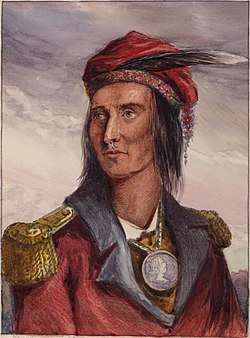
Tecumseh, by Benson Lossing in 1848 based on 1808 drawing.
Native Americans had non concluded their resistance. In the early 19th century, the Shawnee leader Tecumseh gained renown for organizing his namesake confederacy to oppose American expansion in Native American lands. The resulting conflict came to be known as Tecumseh'southward State of war. The two master adversaries in the conflict, primary Tecumseh and American pol William Henry Harrison, had both been inferior participants in the Battle of Fallen Timbers at the shut of the Northwest Indian Wars in 1794. Tecumseh was not amid the Native American signers of the Treaty of Greenville, which had ended the war, when the Shawnee and other Native Americans ceded much of their historic territory in nowadays-24-hour interval Ohio to the United states. However, many Indian leaders in the region accepted the Greenville terms, and for the next ten years pan-tribal resistance to American hegemony faded.
In September 1809 William Henry Harrison, then governor of the Indiana Territory, invited the Potawatomi, Lenape, Eel River people, and the Miami to a meeting in Fort Wayne, Indiana. In the negotiations, Harrison promised large subsidies and payments to the tribes if they would cede the lands he was request for.[30] After ii weeks of negotiating, the Potawatomi leaders convinced the Miami to accept the treaty every bit reciprocity, considering the Potawatomi had earlier accepted treaties less advantageous to them at the request of the Miami. Finally the tribes signed the Treaty of Fort Wayne on September 30, 1809, thereby selling the United States over three,000,000 acres (approximately 12,000 kmtwo), chiefly along the Wabash River due north of Vincennes, Indiana.[thirty]
Tecumseh was outraged by the Treaty of Fort Wayne, believing that American Indian land was owned in common past all tribes, an thought advocated in previous years by the Shawnee leader Blue Jacket and the Mohawk leader Joseph Brant.[31] In response, Tecumseh began to expand on the teachings of his brother, known as Tenskwatawa, a spiritual leader known as The Prophet, who called for the tribes to return to their ancestral ways. He began to associate these teachings with the idea of a pan-tribal brotherhood. Tecumseh traveled widely, urging warriors to carelessness accommodationist chiefs and to bring together the resistance at Prophetstown.[31]

In Baronial 1810, Tecumseh led 400 armed warriors to confront Governor Harrison in Vincennes. Tecumseh demanded that Harrison nullify the Fort Wayne treaty, threatening to impale the chiefs who had signed it.[32] Harrison refused, proverb that the Miami were the owners of the land and could sell information technology if they and so chose.[33] Tecumseh left peacefully, but warned Harrison that he would seek an brotherhood with the British unless the treaty was nullified.[34]
Corking Comet of 1811 and Tekoomsē [edit]
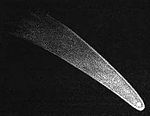
In March the Great Comet of 1811 appeared. During the next year, tensions between American colonists and Native Americans rose quickly. 4 settlers were murdered along the Missouri River and, in another incident, natives seized a boatload of supplies from a group of traders. Harrison summoned Tecumseh to Vincennes to explain the actions of his allies.[34] In Baronial 1811, the two leaders met, with Tecumseh assuring Harrison that the Shawnee intended to remain at peace with the United states.
After Tecumseh traveled to the Southeast on a mission to recruit allies confronting the United States from amidst the "5 Civilized Tribes." His name Tekoomsē meant "Shooting Star" or "Panther Across The Heaven."[35]
Tecumseh told the Choctaw, Chickasaw, Muscogee, and many others that the comet of March 1811 had signaled his coming. He also said that the people would see a sign proving that the Smashing Spirit had sent him.
While Tecumseh was traveling, both sides readied for the Battle of Tippecanoe. Harrison assembled a minor force of army regulars and militia to combat the Native forces.[36] On Nov 6, 1811, Harrison led this army of virtually 1,000 men to Prophetstown, Indiana, hoping to disperse Tecumseh's confederacy.[37] Early next morning time, forces nether The Prophet prematurely attacked Harrison'south army at the Tippecanoe River near the Wabash. Though outnumbered, Harrison repulsed the attack, forcing the Natives to retreat and carelessness Prophetstown. Harrison's men burned the hamlet and returned abode.[38]
New Madrid earthquake [edit]
On December 11, 1811, the New Madrid convulsion shook the Muscogee lands and the Midwest. While the interpretation of this issue varied from tribe to tribe, they agreed that the powerful earthquake had to have spiritual significance. The convulsion and its aftershocks helped the Tecumseh resistance movement every bit the Muscogee and other Native American tribes believed it was a sign that the Shawnee must be supported and that Tecumseh had prophesied such an event and sign.
The Indians were filled with great terror ... the trees and wigwams shook exceedingly; the water ice which skirted the margin of the Arkansas river was broken into pieces; and most of the Indians thought that the Keen Spirit, angry with the human race, was about to destroy the world.
—Roger L. Nichols, The American Indian
Tribal involvement in the War of 1812 [edit]

The New Madrid earthquake was interpreted by the Muscogee as a reason to back up the Shawnee resistance.
The Muscogee (Creek) who joined Tecumseh'due south confederation were known as the Red Sticks. They were the more bourgeois and traditional role of the people, as their communities in the Upper Towns were more than isolated from European-American settlements. They did not desire to digest. The Cherry-red Sticks rose in resisting the Lower Creek, and the bands became involved in civil state of war, known as the Creek State of war. This became part of the State of war of 1812 when open conflict broke out between American soldiers and the Red Sticks of the Creek.[39]

Portraits of the Choctaw chief Pushmataha (left) and Tecumseh.
—Pushmataha, 1811 – Sharing Choctaw History.[40]
—Tecumseh, 1811[41] [42]
After William Hull's surrender of Detroit to the British during the State of war of 1812, General William Henry Harrison was given command of the U.S. Army of the Northwest. He set up out to retake the city, which was defended by British Colonel Henry Procter, together with Tecumseh and his forces. A detachment of Harrison's army was defeated at Frenchtown along the River Raisin on Jan 22, 1813. Some prisoners were taken to Detroit, simply Procter left those besides injured to travel with an inadequate guard. His Native American allies attacked and killed perhaps as many as 60 wounded Americans, many of whom were Kentucky militiamen.[43] The Americans called the incident the "River Raisin Massacre." The defeat ended Harrison's campaign against Detroit, and the phrase "Think the River Raisin!" became a rallying cry for the Americans.
In May 1813, Procter and Tecumseh besieged Fort Meigs in northern Ohio. American reinforcements arriving during the siege were defeated by the Natives, but the garrison in the fort held out. The Indians eventually began to disperse, forcing Procter and Tecumseh to return to Canada. Their second offensive in July against Fort Meigs likewise failed. To improve Indian morale, Procter and Tecumseh attempted to tempest Fort Stephenson, a small American post on the Sandusky River. Afterwards they were repulsed with serious losses, the British and Tecumseh ended their Ohio campaign.
On Lake Erie, the American commander Captain Oliver Hazard Perry fought the Battle of Lake Erie on September 10, 1813. His decisive victory against the British ensured American control of the lake, improved American morale after a series of defeats, and compelled the British to fall dorsum from Detroit. Full general Harrison launched another invasion of Upper Canada (Ontario), which culminated in the U.South. victory at the Battle of the Thames on October 5, 1813. Tecumseh was killed there, and his death effectively ended the North American indigenous alliance with the British in the Detroit region. American control of Lake Erie meant the British could no longer provide essential armed forces supplies to their aboriginal allies, who dropped out of the war. The Americans controlled the area during the balance of the conflict.
Aftermath [edit]
The Shawnee in Missouri migrated from the The states southward into Mexico, in the eastern role of Spanish Texas. They became known as the "Absentee Shawnee." They were joined in the migration past some Delaware (Lenape). Although they were closely allied with the Cherokee led by The Basin, their principal John Linney remained neutral during the 1839 Cherokee War.[44]
Texas achieved independence from Mexico under American leaders. It decided to force removal of the Shawnee from the new republic. Simply in appreciation of their earlier neutrality, Texan President Mirabeau Lamar fully compensated the Shawnee for their improvements and crops. They were forced out to Arkansas Territory.[44] The Shawnee settled close to present-solar day Shawnee, Oklahoma. They were joined by Shawnee pushed out of Kansas (see beneath), who shared their traditionalist views and beliefs.
In 1817, the Ohio Shawnee had signed the Treaty of Fort Meigs, ceding their remaining lands in substitution for three reservations in Wapaughkonetta, Squealer Creek (near Lima), and Lewistown, Ohio. They shared these lands with some Seneca people who had migrated w from New York.
In a series of treaties, including the Treaty of Lewistown of 1825, Shawnee and Seneca people agreed to exchange land in western Ohio with the United States for land west of the Mississippi River in what became Indian Territory.[45] In July 1831, the Lewistown group of Seneca–Shawnee departed for the Indian Territory (in nowadays-24-hour interval Kansas and Oklahoma).
The main body of Shawnee in Ohio followed Black Hoof, who fought every endeavor to force his people to surrender their homeland. Afterwards the expiry of Blackness Hoof, the remaining 400 Ohio Shawnee in Wapaughkonetta and Grunter Creek surrendered their land and moved to the Shawnee Reserve in Kansas. This motion was largely nether terms negotiated by Joseph Parks (1793-1859). He had been raised in the household of Lewis Cass and had been a leading interpreter for the Shawnee.[46]
Missouri joined the Wedlock in 1821. After the Treaty of St. Louis in 1825, the ane,400 Missouri Shawnee were forcibly relocated from Greatcoat Girardeau, forth the due west bank of the Mississippi River, to southeastern Kansas, close to the Neosho River.
During 1833, but Blackness Bob's band of Shawnee resisted removal. They settled in northeastern Kansas near Olathe and along the Kansas (Kaw) River in Monticello almost Gum Springs. The Shawnee Methodist Mission was built nearby to minister to the tribe. About 200 of the Ohio Shawnee followed the prophet Tenskwatawa and had joined their Kansas brothers and sisters here in 1826.
In the mid-1830s 2 companies of Shawnee soldiers were recruited into The states service to fight in the Seminole War in Florida. I of these was led by Joseph Parks, who had earlier helped negotiate the cession treaty. He was commissioned as helm. Parks was a major landholder in both Westport, Missouri and in Shawnee, Kansas. He was as well a Freemason and a member of the Methodist Episcopal Church building. In Shawnee, Kansas, a Shawnee cemetery was started in the 1830s and remained in use until the 1870s. Parks was among the near prominent men buried there.[46]
In the 1853 Indian Appropriations Bill, Congress appropriated $64,366 for treaty obligations to the Shawnee, such as annuities, education, and other services. An boosted $2,000 was appropriated for the Seneca and the Shawnee together.[47]
During the American Civil War, Black Bob'southward band fled from Kansas and joined the "Absentee Shawnee" in Indian Territory to escape the war. After the Civil State of war, the Shawnee in Kansas were expelled and forced to motility to northeastern Oklahoma. The Shawnee members of the former Lewistown group became known every bit the "Eastern Shawnee".
The former Kansas Shawnee became known as the "Loyal Shawnee" (some say this is because of their allegiance with the Spousal relationship during the war; others say this is considering they were the final group to go out their Ohio homelands). The latter group appeared to be regarded as office of the Cherokee Nation by the United states of america. They were also known every bit the "Cherokee Shawnee" and were settled on some of the Cherokee land in Indian Territory.
Federal recognition [edit]
In the late 20th century, the "Loyal" or "Cherokee" Shawnee began a motility to exist federally recognized equally a tribe contained of the Cherokee Nation.[48] They received this action by a Congressional bill and are now known as the "Shawnee Tribe". Today, most members of the three federally recognized tribes of the Shawnee nation reside in Oklahoma.
Social and kinship groups [edit]
Before contact with Europeans, the Shawnee tribe had a patrilineal system, by which descent and inheritance went through paternal lines. This was different from many of the Native American tribes, who had matrilineal kinship systems. In that alternative, children were considered born to the mother's family unit and clan, and inheritance and property was passed through the female line.[49] [ amend source needed ]
According to mid-19th century historian Henry Harvey, the Shawnee were ruled by kings, whom they called sachema [or sachems], who reigned by succession in the matrilineal line. For instance, the children of a king would non inherit the position. The sons of his brother, by the mother, or the sons of his sis (and afterwards them, the sons of her daughter) would reign. Women did not inherit such a position straight. Harvey suggested that the Shawnee relied on this organization of descent considering a woman's sons would ever be considered legitimate.[50]
The five divisions, or septs, of the tribe were commonly known as:
- Chillicothe (Chief Identify), Chalahgawtha, Chalaka, Chalakatha; The Primary sectionalization of "Tschillicothi", appointed by the 1st Pb Illini or human being Kwikullay.
- Hathawekela, Thawikila;
- Kispoko, Kispokotha, Kishpoko, Kishpokotha; [from ishpoko equally alike to the Ispogi, meaning swamps or marshy lands of the Muscogi or Creeks, most specific to the Tukabatchi]
- Mekoche, Mequachake, Machachee, Maguck, Mackachack, etc.; Mackochee
- Pekowi, Pekuwe, Piqua, Pekowitha. [Pickywanni or pickquay]
The war chiefs were also hereditary. They descended from their maternal line in the Kispoko partition.[16]
A 1935 report noted that the Shawnee had 5 septs, and that they were besides divided amidst half-dozen clans or subdivisions, according to kinship. Each association represented spiritual values and had a recognized role in the overall confederacy.[51] Each name group or association is found amid each of the v divisions, and each Shawnee belongs to a association or name group.[51]
The six group names are:
- Pellewomhsoomi (Turkey name grouping)—represents bird life,
- Kkahkileewomhsoomi (Turtle name group)—represents aquatic life,
- Petekoθiteewomhsoomi (Rounded-feet name group)—represents carnivorous animals such as the dog, wolf, or those with paws that are ball-shaped or "rounded,"
- Mseewiwomhsoomi (Horse name group)—represents herbivorous animals such as the horse and deer,
- θepatiiwomhsoomi (Raccoon name group)—represents animals having paws which tin rip and tear, such as those of a raccoon and bear.
- Petakineeθiiwomhsoomi (Rabbit proper name group)—represents a gentle and peaceful nature.[51]
Each sept or sectionalisation had a primary hamlet where the chief of the sectionalisation lived. This village was ordinarily named after the division. By tradition, each Shawnee partition and clan had certain roles it performed on behalf of the entire tribe. By the time these kinship elements were recorded in writing past European Americans, these strong social traditions were fading. They are poorly understood. Because of the disruption and scattering of the Shawnee people from the 17th century through the 19th century, the roles of the divisions changed.
Today the United states of america authorities recognizes 3 Shawnee tribes, all of which are located in Oklahoma:
- The Absentee-Shawnee Tribe of Indians of Oklahoma, consisting mainly of Hathawekela, Kispokotha, and Pekuwe divisions;
- The Eastern Shawnee Tribe of Oklahoma, by and large of the Mekoche division; and
- The Shawnee Tribe, formerly considered part of the Cherokee Nation, mostly of the Chaalakatha and Mekoche divisions. Petakineeθiiwomhsoomi (Rabbit proper name group) represents a gentle and peaceful nature, that stands lonely equally the Tail or last.
Every bit of 2008, there were 7,584 enrolled Shawnee, with most living in Oklahoma.[52]
Land-recognized tribe [edit]
The state of Alabama recognizes an organization, the Piqua Shawnee Tribe, as a state-recognized tribe nether the Davis-Stiff Act.[53] [54]
Ohio does not recognize any Shawnee tribes.[55] [56] [57]
Unrecognized groups who claim Shawnee descent [edit]
Numerous other groups claim Shawnee ancestry, including:[58]
- Chickamauga Keetoowah Unami Wolf Ring of Cherokee Delaware Shawnee of Ohio, Due west Virginia, and Virginia
- Due east of the River Shawnee, Ohio
- Kispoko Sept of Ohio Shawnee, Louisiana
- Kispoko Sept of Ohio Shawnee (Grunter Creek Reservation), Ohio
- Lower Eastern Ohio Mekoce Shawnee, Ohio Letter of the alphabet of Intent to Petition 3/5/2001.[59] [sixty] [61] [62]
- Lower Eastern Ohio Mekojay Shawnee, Ohio
- Morning Star Shawnee Nation, Ohio
- Piqua Sept of Ohio Shawnee Indians, Ohio
- Platform Reservation Remnant Ring of the Shawnee Nation[63] [64] [65] [66]
- Shawnee Nation Blue Creek Ring, of Adams Canton, Ohio. Letter of Intent to Petition viii/v/1998.[59] [67] [68]
- Piqua Shawnee Tribe / Piqua Sept of Ohio Shawnee Tribe—Alphabetic character of Intent to Petition 04/16/1991.[59]
- Ridgetop Shawnee, Kentucky. In 2009 and 2010, the State House of the Kentucky Full general Assembly referred to the Ridgetop Shawnee Tribe of Indians in House Articulation Resolutions 15 or HJR-xv and HJR-16.[69] [70]
- Southeastern Kentucky Shawnee, Kentucky
- United Remnant Ring of the Shawnee Nation, Ohio[71] [72]
- United Tribe of Shawnee Indians, Kansas
- Upper Kispoko Band of the Shawnee Nation, Indiana, recognized by the State of Indiana in the late 1980s.
- Vinyard Indian Settlement of Shawnee Indians, Illinois
- Youghiogaheny River Ring Of Shawnee Indians, Maryland
These organizations are non federally recognized or state-recognized.
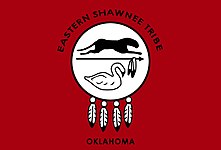
Flags of the Shawnee [edit]


Coins of the Shawnee Tribe [edit]
-

Outset Shawnee Tribe coin issue: 2002—ane dollar
-

Tecumseh commemorative dollar
Notable historic Shawnees [edit]
Shawnee people from the 20th and 21st centuries are listed under their specific tribes.
- Big Hominy (Meshemethequater, 1690-1758), a respected warrior known for participating in peace conferences that prevented war between English settlers and the Shawnees
- Black Bob (Wawahchepaehai or Wawahchepaekar), 19th-century leader and war chief in Ohio
- Black Hoof (Catahecassa, 1740–1831), respected Shawnee chief who believed his people needed to accommodate to European-American culture to survive.
- Black Serpent (Peteusha) and Big Snake (Shemanetoo), active in Lord Dunmore's War, the American Revolutionary War, and the Northwest Indian War
- Blackfish (Chiungalla, 1729-1779), a Shawnee primary of the Chillicothe division of the Shawnee tribe.
- Blue Jacket (Waweyapiersenwaw, "Blue Jacket," 1743–1810), a leader in the Northwest Indian War and important early supporter of Tecumseh
- Peter Chartier (Wacanackshina, "White I Who Reclines" - 1690–1759), French-Canadian/Shawnee who opposed the auction of alcohol in Shawnee communities and fought on the side of the French in the French and Indian War.
- Chiksika (Chiuxca, "Black Stump," 1760–1792), Kispoko war master and older brother of Tecumseh
- Cornstalk (Hokolesqua, 1720–1777), led the Shawnee in Dunmore'due south State of war of 1774.
- George Drouillard (1773–1810), French-Canadian/Shawnee who served every bit sentry on the Lewis and Clark Expedition
- Kakowatcheky (d. ca. 1755),[73] : 500 a meaning leader in 1694 and a Shawnee chief every bit early as 1709 who moved to Logstown in 1744.[74] [75]
- Kekewepelethy (Helm Johnny, d. c. 1808), master ceremonious chief of the Shawnees in the Ohio Country during the Northwest Indian War
- Captain Logan (Spemica Lawba, "High Horn," c. 1776–1812), noted spotter and interpreter on American side during the War of 1812
- Neucheconeh, (d. ca. 1748), principal of the western Pennsylvania Shawnee who campaigned confronting the unrestricted sale of alcohol in Shawnee communities.
- Nonhelema (1720–1786), sister of Cornstalk, helped compile the dictionary for the Shawnee language.
- Opessa Straight Tail (Wapatha, 1664-1750), became master of his Pekowi ring in 1697 and signed several peace treaties with William Penn before leading his people to the Ohio River Valley in ca. 1727
- Tecumseh (c. 1768–1813), Shawnee leader; with his brother Tenskwatawa attempted to unite tribes west of the Appalachians against the expansion of European-American settlement.
- Tenskwatawa ("The Open Door," 1775–1836), Shawnee prophet and younger brother of Tecumseh
Encounter also [edit]
- Battle of Tippecanoe Outdoor Drama
Notes [edit]
- ^ a b Oklahoma Indian Affairs Commission. Oklahoma Indian Nations Pocket Pictorial. Archived February xi, 2009, at the Wayback Machine 2008.
- ^ a b c Callender, "Shawnee," 623.
- ^ "Algonquian, Algic". Ethnologue . Retrieved October five, 2021.
- ^ "Shawnee". Ethnologue . Retrieved April 28, 2016.
- ^ O'Donnell, James H. Ohio's Offset Peoples, p. 31. Athens, Ohio: Ohio University Press, 2004. ISBN 0-8214-1525-5 (paperback), ISBN 0-8214-1524-seven (hardcover)
- ^ Howard, James H. Shawnee!: The Ceremonialism of a Native Indian Tribe and its Cultural Background, p. ane. Athens, Ohio: Ohio University Press, 1981. ISBN 0-8214-0417-2; ISBN 0-8214-0614-0 (pbk.)
- ^ Schutz, Noel W., Jr.: The Study of Shawnee Myth in an Ethnographic and Ethnohistorical Perspective, Ph.D. dissertation, Department of Anthropology, Indiana Academy, 1975.
- ^ a b Peregrine, Peter Neal; Ember, Melvin, eds. (2003). "Encyclopedia of Prehistory: Volume 6: Due north America". Encyclopedia of Prehistory. Vol. 6 : N America (i ed.). Springer Publishing. pp. 175–184. ISBN0-306-46260-5.
- ^ Drooker, Penelope B. (1997). The View from Madisonville: Protohistoric Western Fort Ancient Interaction Patterns. University of Michigan Press. p. 203. ISBN9780915703425.
- ^ Clark, Jerry. "Shawnees". Tennessee Encyclopedia of Culture and History . Retrieved September xi, 2008.
- ^ Voegelin, Carl F. 1938–forty. "Shawnee Stems and the Jacob P. Dunn Miami Dictionary." Indiana Historical Lodge Prehistory Research Series Volume one, No. 8, Part Iii, p. 318 (October, 1939). Indianapolis.
- ^ "Shawnee Myth. Story of a Twelvemonth. Former Sawage and her Grandson." MS 3906, Smithsonian Institution National Anthropological Archives. Myth nerveless past Jeremiah Curtin. 1850s-1880s.
- ^ C. F. Voeglin, fieldwork notebook XII, "Big Sacred Cadger"; fieldwork 1933–34.
- ^ Transcribed by Bruno Neti about 1951 from Shawnee Song cylinders collected by C. F. Voegelin and now in the Archives of Traditional Music at Indiana University. Sheet eight, Song 38.
- ^ Charles Augustus Hanna, The Wilderness Trail: Or, The Ventures and Adventures of the Pennsylvania Traders on the Allegheny Path, Volume i, New York: Putnam's sons, 1911, esp. chap. 4, "The Shawnees", pp. 119–160.
- ^ a b c Kleber, John Due east. (May 18, 1992). The Kentucky Encyclopedia. Academy Press of Kentucky. p. 815. ISBN978-0-8131-2883-two . Retrieved February 17, 2013.
- ^ Carrie Hunter Willis and Etta Belle Walker, Legends of the Skyline Drive and the Nifty Valley of Virginia, 1937, pp. 15–16; this account also appears in T.K. Cartmell's 1909 Shenandoah Valley Pioneers and Their Descendants p. 41.
- ^ Edward Bland, The Discoverie of New Brittaine
- ^ McWilliams, Richebourg; Iberville, Pierre (February 28, 1991). Iberville's Gulf Journals. Academy of Alabama Press. p. 175. ISBN9780817305390.
- ^ Jerry Eastward. Clark, The Shawnee, Academy Press of Kentucky, 1977. ISBN 0813128188
- ^ Gallay, Alan. The Indian Slave Merchandise: The Rise of the English Empire in the American South, 1670–1717, p. 55. New Haven: Yale University Press, 2002. ISBN 0-300-10193-7
- ^ Not to be confused with the nearby French Margaret'southward Town; see John Franklin Meginness, Otzinachson: A History of the Westward Branch Valley of the Susquehanna (rev. ed., Williamsport, PA, 1889), 1:94. Ostonwakin is also spelled Otstonwakin.
- ^ Stephen Warren, Worlds the Shawnees Made: Migration and Violence in Early America, UNC Press Books, 2014 ISBN 1469611732
- ^ Legends of the Skyline Drive and the Great Valley of Virginia, pp. 16–17.
- ^ Joseph Doddridge, 1850, A History of the Valley of Virginia, p. 44
- ^ Calloway, Colin (2007). The Shawnees and the War for America . New York: Viking. pp. 13. ISBN978-0-670-03862-6.
- ^ Library of Congress, Transcript of the Journal of Nicholas Cresswell
- ^ Gevinson, Alan. "Which Native American Tribes Centrolineal Themselves with the French?" Teachinghistory.org, accessed September 23, 2011.
- ^ a b Colin One thousand. Calloway, "'We Have Ever Been the Frontier': The American Revolution in Shawnee Country," American Indian Quarterly (1992) xvi#1 pp 39-52. in JSTOR
- ^ a b Owens, Robert M. (2007). Mr. Jefferson'southward Hammer: William Henry Harrison and the Origins of American Indian Policy. Norman, Oklahoma: Academy of Oklahoma Printing. pp. 201–203. ISBN978-0-8061-3842-viii.
- ^ a b Owens, p. 212
- ^ Langguth, p. 164
- ^ Langguth, p. 165
- ^ a b Langguth, p. 166
- ^ George Blanchard, Governor of the Absentee Shawnee Tribe of Oklahoma, so describes the meaning of the proper name in the PBS documentary We Shall Remain: Tecumseh's Vision Archived May 4, 2012, at the Wayback Auto:
Well, I've ever heard 'Teh-cum-theh'—'Teh-cum-theh'—means, in our civilisation and our belief, at nights when we see a falling star, it means that this panther is jumping from i mount to another. And as kids, we saw these falling stars, nosotros'd kind of hesitate about being out in the dark, considering nosotros thought there were really panthers out at that place walking around. So that's what his name meant: Teh-cum-theh.
- ^ Langguth, p. 168
- ^ Funk, Arville (1983) [1969]. A Sketchbook of Indiana History. Rochester, Indiana: Christian Book Printing.
- ^ Langguth, p. 169
- ^ Langguth, p. 167
- ^ Jones, Charile (November 1987). "Sharing Choctaw History". Bishinik. Retrieved October i, 2013.
- ^ Sherman, William Tecumseh. "H.B. Cushman, History of the Choctaw, Chickasaw and Natchez Indians (Greenville, Texas: 1899), 310 ff., quoted in "Survival Strategies"". Digital History. Academy of Houston. Retrieved April 28, 2016.
- ^ Turner III, Frederick (1978) [1973]. "Poetry and Oratory". The Portable North American Indian Reader. Penguin Book. pp. 246–247. ISBN0-fourteen-015077-iii.
- ^ "Kentucky: National Guard History eMuseum – State of war of 1812". Kynghistory.ky.gov. Archived from the original on March 2, 2009. Retrieved October 22, 2008.
- ^ a b Lipscomb, Carol A.: "Shawnee Indians" from the Handbook of Texas Online. Retrieved February 21, 2010.
- ^ "Treaty with the Shawnee, 1825, Article 5, Folio 264". Oklahoma State Academy. November seven, 1825. Retrieved May viii, 2020.
- ^ a b Social club, Kansas State Historical (March 27, 2019). Collections of the Kansas Country Historical Society. The Kansas State Historical Society. p. 399 – via Net Archive.
Joseph Parks Shawnee.
- ^ "Indian Cribbing" (PDF). The New York Times. March 15, 1853. p. 3.
- ^ "Text of S. 3019 (106th): Shawnee Tribe Condition Act of 2000 (Introduced version)". GovTrack.us. Civic Impulse. September 7, 2000. Retrieved May 8, 2020.
- ^ Harvey, Henry (1855). History of the Shawnee Indians: From the Year 1681 to 1854, Inclusive. Cincinnati: Ephraim Morgan & Sons. p. 18.
- ^ Harvey, Henry (1855). "one". History of the Shawnee Indians: From the Year 1681 to 1854, Inclusive. Cincinnati: Ephraim Morgan & Sons. p. 18.
- ^ a b c Voegellin, C.F. and Voegelin, Eastward. W. (1935). "Shawnee Name Groups". American Anthropologist. 37 (4): 617–635. doi:10.1525/aa.1935.37.four.02a00070.
{{cite journal}}: CS1 maint: uses authors parameter (link) - ^ Oklahoma Indian Committee. Oklahoma Indian Nations Pocket Pictorial. Archived February 11, 2009, at the Wayback Motorcar 2008
- ^ "Tribes". aiac.state.al.u.s.a..
- ^ "State Recognized Tribes". National Conference of State Legislatures . Retrieved July 14, 2018.
- ^ Watson, Blake A. "Indian Gambling in Ohio: What are the Odds?" (PDF). Capital University Law Review 237 (2003) (excerpts). Archived from the original (PDF) on September 27, 2007. Retrieved September xxx, 2007.
Ohio in any outcome does not officially recognize Indian tribes.
nor does Kentucky. - ^ Koenig, Alexa; Stein, Jonathan. "Federalism and the Land Recognition of Native American Tribes: A Survey of Country-Recognized Tribes and State Recognition Processes Beyond the Usa". Santa Clara Police Review Volume 48 (forthcoming). pp. Section 12. Ohio. Retrieved September thirty, 2007.
Ohio recognizes one country tribe, the United Remnant Band. . . . Ohio does not have a detailed scheme for regulating tribal-state relations.
- ^ "Early History". The Piqua Shawnee Tribe of Alabama . Retrieved February 17, 2013.
- ^ "SHAWNEE TODAY". Big Bear's Den. 2012. Retrieved February 17, 2013.
- ^ a b c "Ohio Indian Tribes". AAANativeArts.com . Retrieved February 17, 2013.
- ^ "Native American Peace Tree Anniversary guest is former Shawnee Chief". Eberly College of Arts and Sciences. W Virginia University. October vii, 2009. Archived from the original on June 12, 2010. Retrieved Feb 17, 2013.
- ^ "Lower Eastern Ohio Mekoce Shawnee in Wilmington, Ohio (OH)". faqs.org, Revenue enhancement-Exempt Organizations. 2013. Retrieved February 17, 2013.
- ^ "The Inter Tribal Learning Circle". Fort Ancient. Archived from the original on August i, 2013. Retrieved Feb 17, 2013.
- ^ "Platform Reservation Remnant Band". Retrieved February 17, 2013.
- ^ "Platform Reservation Remnant Band Church building Of The Shawnee Inc. - Indiana Company Profile". Bizapedia. Apr 26, 2012. Retrieved February 17, 2013.
- ^ Patricia Lowry (June 26, 2006). "Places: Nearly Fort Necessity, a National Road inn is reclaiming 1830s interior". Pittsburgh Post-Gazette . Retrieved February 17, 2013.
- ^ Paul Johnson (January 22, 2008). "Native American Tribe Works Toward National Recognition". TheLedger.com . Retrieved Feb 17, 2013.
- ^ "Shawnee Nation - Ohio Blue Creek Band, Inc. - Ohio Company Profile". Bizapedia. November 28, 2011. Retrieved February 17, 2013.
- ^ "Re: [NA-SHAWNEE] the Indiana Blue Creek Shawnee scroll". RootsWeb: NA-SHAWNEE-L . Retrieved Feb 17, 2013.
At that place was no Blue Creek Band in Indiana...that'southward our Ring here indigenous to Ohio...documented equally late every bit 1870. You are looking for the Blue River Band.
- ^ "Kentucky General Assembly 2010 Regular Session HJR-16". kentucky.gov, updated ix-2-2010.
- ^ "Kentucky General Assembly 2009 Regular Session HJR-15". kentucky.gov, updated five-2-2009. Archived from the original on March 4, 2016. Retrieved January xxx, 2012.
- ^ "American Indians in Ohio" Archived August xiii, 2007, at the Wayback Motorcar, Ohio Memory: An Online Scrapbook of Ohio History, The Shawnee Nation United Remnant Band, The Ohio Historical Society, retrieved September 30, 2007
- ^ "Joint Resolution to recognize the Shawnee Nation United Remnant Band" equally adopted by the [Ohio] Senate, 113th General Assembly, Regular Session, Am. Sub. H.J.R. No. 8, 1979–1980
- ^ Mulkearn, Lois. George Mercer Papers: Relating to the Ohio Company of Virginia. Academy of Pittsburgh Printing, 1954.
- ^ Paul A. Due west. Wallace, Indians in Pennsylvania, DIANE Publishing Inc., 2007, p. 127. ISBN 1422314936
- ^ Kakowatchiky
References [edit]
- Callender, Charles. "Shawnee", in Northeast: Handbook of North American Indians, vol. fifteen, ed. Bruce Trigger. Washington, DC: Smithsonian Institution, 1978: 622–35. ISBN 0-sixteen-072300-0
- Clifton, James A. Star Woman and Other Shawnee Tales. Lanham, MD: University Press of America, 1984. ISBN 0-8191-3712-Ten; ISBN 0-8191-3713-viii (pbk.)
- Edmunds, R. David. The Shawnee Prophet. Lincoln: Academy of Nebraska Press, 1983. ISBN 0-8032-1850-8.
- Edmunds, R. David. Tecumseh and the Quest for Indian Leadership. Originally published 1984. 2d edition, New York: Pearson Longman, 2006. ISBN 0-321-04371-five
- Edmunds, R. David. "Forgotten Allies: The Loyal Shawnees and the State of war of 1812" in David Curtis Skaggs and Larry 50. Nelson, eds., The Sixty Years' War for the Great Lakes, 1754–1814, pp. 337–51. Due east Lansing: Michigan State University Printing, 2001. ISBN 0-87013-569-4.
- Langguth, A. J. (2006). Union 1812: The Americans Who Fought the Second War of Independence. New York: Simon & Schuster. ISBN0-7432-2618-6.
- Howard, James H. Shawnee!: The Ceremonialism of a Native Indian Tribe and its Cultural Background. Athens, Ohio: Ohio University Press, 1981. ISBN 0-8214-0417-2; ISBN 0-8214-0614-0 (pbk.)
- Lakomäki, Sami. Gathering Together: The Shawnee People through Diaspora and Nationhood, 1600-1870. New Haven, CT: Yale University Printing, 2014.
- O'Donnell, James H. Ohio's First Peoples. Athens, Ohio: Ohio University Press, 2004. ISBN 0-8214-1525-5 (paperback), ISBN 0-8214-1524-7 (hardcover).
- Sugden, John. Tecumseh: A Life. New York: Holt, 1997. ISBN 0-8050-4138-ix (hardcover); ISBN 0-8050-6121-five (1999 paperback).
- Sugden, John. Blue Jacket: Warrior of the Shawnees. Lincoln and London: Academy of Nebraska Press, 2000. ISBN 0-8032-4288-iii.
External links [edit]
 | Wikimedia Commons has media related to Shawnee. |
- . Encyclopædia Britannica. Vol. 24 (11th ed.). 1911.
Federally recognized Shawnee tribes [edit]
- Absentee Shawnee Tribe of Oklahoma, official website
- Eastern Shawnee Tribe of Oklahoma, official website
- Shawnee Tribe of Oklahoma, official website
Shawnee history [edit]
- Shawnee History
- Shawnee Indian Mission
- "Shawnee Indian Tribe", Access Genealogy
- Treaty of Fort Meigs, 1817, Central Michigan Country University
- BlueJacket
kulikowskidins1974.blogspot.com
Source: https://en.wikipedia.org/wiki/Shawnee
0 Response to "What Kind of Art Di D the Shawnee Do"
Post a Comment